FarmVille 2: Tropic Escape
- 4.0
- Rating
- 10.00M
- Installs
- Free
- Price

 Analysis by App-foxy
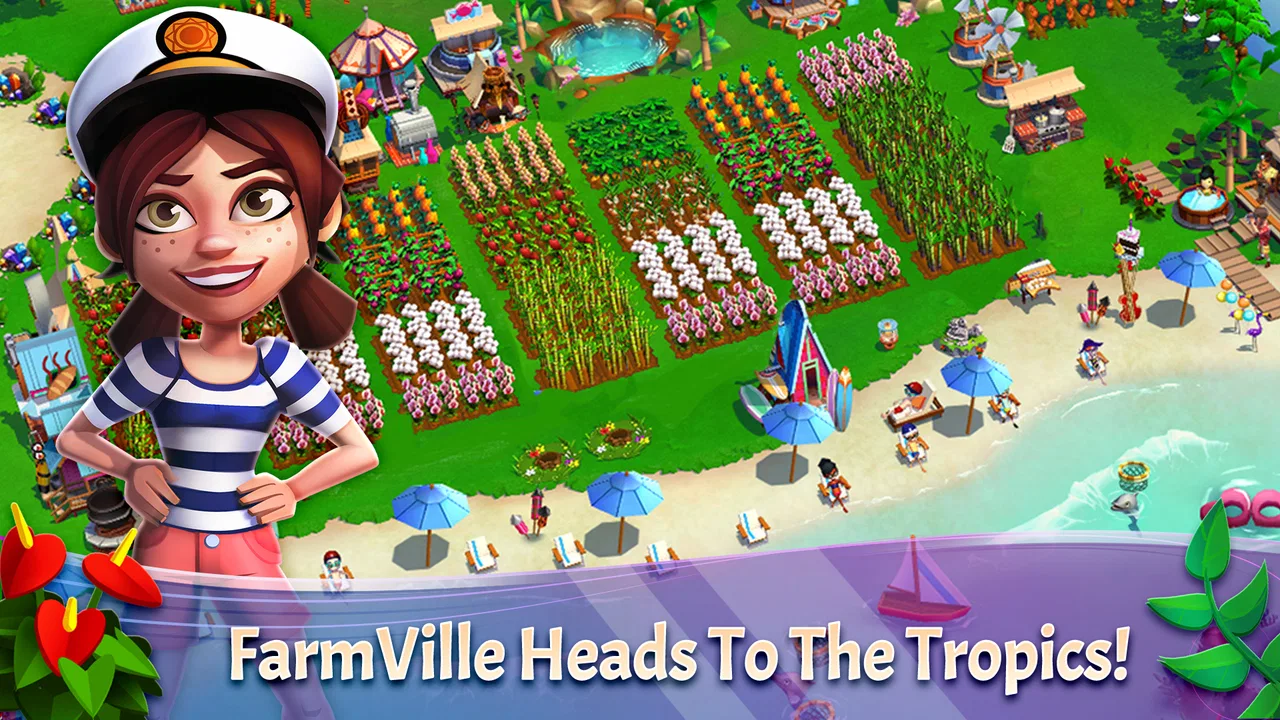
FarmVille 2: Tropic Escape is the kind of simulation game I open when I want a gentle routine rather than a demanding challenge. Developed by Zynga, it places farming in a tropical setting and adds an island story with exotic animals, giving the familiar planting-and-producing loop a more relaxed holiday atmosphere. I found it easy to understand within minutes, but there is enough planning behind the cheerful presentation to keep the island from feeling completely automatic.
The game is free to download and suitable for Everyone, which makes it approachable for casual players and families. It has reached over ten million installs, with an average rating of 4.0 from around 409 thousand ratings. Those figures suggest a broad audience, although they also hint at a game that works very well for some play styles and less well for others. My own view is that it succeeds when treated as a slow, ongoing hobby rather than a game to rush through.
Planning an island instead of simply tapping through tasks
The first important decision is how I use limited attention. FarmVille 2: Tropic Escape constantly presents appealing things to do: grow crops, develop production, follow the island’s story and interact with unusual animals. The temptation is to accept every available request immediately, but that can leave me without the materials needed for a more useful goal later. I get better results when I decide what I am preparing for before filling every available action.
You May Also Like

 Blood Strike: 2.5 Anniversary
Blood Strike’s Loadouts Turn Every Drop Into a Tactical Gamble
A close look at Blood Strike’s custom loadouts: how fast access to signature weapons reshapes its battle royale rhythm, rewards preparation, and narrows the gap between fights.

 Pandora - Music & Podcasts
Pandora’s Music Is Easy to Start, but Harder to Recover
Pandora’s strength is its low-effort path from a seed to a station. Its weak spot is how much confidence it asks you to place in connection, setup, and quiet recovery.

 8 Ball Pool
 Is Built on Rivalries, Rematches, and Routine
A close look at the rivalries, rematches, shared routines, and unanswered safety questions that turn a quick pool match into a persistent mobile community.

 Samsung Music
’s Quiet Strength Is Playing What You Already Own
Its reach comes less from spectacle than from dependable access to a personal library. That simplicity is both the app’s strongest retention engine and its ceiling.

 AccuWeather: Weather Radar
AccuWeather Review: A Quick, Clear Forecast for Everyday Decisions
For everyday plans, the best forecast is the one you can understand quickly. AccuWeather makes rain timing, radar, and local conditions easy to act on, with a few trade-offs.

 Hill Climb Racing
Why Hill Climb Racing Still Turns Crashes Into One More Run
A tiny car, a bumpy hill and one more upgrade: Hill Climb Racing keeps resurfacing because its simple chaos makes every near-miss feel personal.
More From Our News Desk
View All News


That small change in attitude gives the game more depth than its bright, friendly style suggests. If I am playing for only a few minutes, I focus on short tasks that fit that window. If I know I will return later, I choose activities that can mature while I am away. This makes the game work naturally around real life, especially for someone who checks a phone during a commute, a lunch break or while waiting for an appointment.
The island setting also helps the game avoid feeling like a plain copy of a conventional countryside farm. Tropical scenery, story progress and exotic animals give the routine a clearer identity. I do not need to learn complicated controls, and the visual language makes it obvious what deserves attention. Even so, the simplicity can become repetitive if I want constant surprises or a strong competitive edge.
How I organize a short play session
My most useful habit is to begin by checking what I already have rather than immediately collecting everything in sight. A quick inventory check tells me whether I should plant for a future production chain, complete a request, or simply clear space for the next cycle. This avoids the common casual-game mistake of spending resources just because an icon is flashing.
I also try to keep one objective in reserve. When every action is committed to the current request, an unexpected need can force a long wait or an unnecessary purchase. Leaving a little flexibility means I can adapt without dismantling the plan I made a moment earlier. It is not dramatic strategy, but it makes the island feel more manageable.
For a realistic everyday example, imagine opening the game before work. I would start longer activities, collect anything that is ready, and avoid beginning a chain that requires several follow-up steps before I can leave. Later, during a short break, I can handle the quick interactions and decide what should run while I sleep. That rhythm is more satisfying than trying to complete everything in one sitting.
Where the decisions become meaningful
The most interesting choices appear when several goals compete for the same resources or time. A request may be attractive because it advances the story, while a production task may prepare something more valuable for the next session. I do not treat every reward as equally useful. I ask whether it solves an immediate problem, opens a new path, or merely creates a temporary feeling of progress.
This is also why I would not recommend blindly following every prompt. Guidance is helpful when I am learning the island, but my priorities become more efficient once I understand my own schedule. A player who checks frequently can afford a different plan from someone who plays once in the evening. Neither approach is wrong; the important point is to match the island’s rhythm to the time I genuinely have.
Managing waiting, spending and changing priorities
The central trade-off is familiar to this type of simulation game: progress feels smooth when I plan ahead, but waiting becomes noticeable when I try to accelerate everything. FarmVille 2: Tropic Escape includes in-app purchases ranging from $0.99 to $199.99 per item, so the free entry point comes with optional spending pressure. I can enjoy the basic loop without paying, but I need discipline if I do not want impatience to decide how I use money.
I see premium currency, where available, as a convenience rather than a solution to poor planning. Spending to remove a single delay may feel harmless, but repeated small decisions can change the entire balance of the game. My practical rule is to reserve purchases for a moment when they genuinely improve my experience, not simply because a timer is visible. If waiting is frustrating from the beginning, this is probably not the right simulation for me.
The strongest reward often comes from preparing before a request becomes urgent. When I use a spare moment to set up future production, the next session feels productive without requiring extra spending. By contrast, reacting only when a task is already due makes every delay feel like a problem. The game therefore rewards a modest planning horizon: I do not need to think far ahead, but I do benefit from preparing one or two steps in advance.
Why rushing weakens the experience
Fast progress can make a new area or story moment appear sooner, but it also removes much of the reason to return. The game is built around repeated visits, and the satisfaction comes from seeing a small plan mature. If I compress every wait, I am left with a sequence of taps rather than a routine. That does not mean acceleration is always bad; it simply changes what I am buying. I am paying for convenience, not discovering a hidden strategic shortcut.
I also watch for the difference between a useful purchase and an emotional one. If I am short of a single item because I mismanaged a previous session, paying may cover the mistake, but it does not teach me how to avoid the same situation. On the other hand, someone with very limited playtime may reasonably value convenience more than I do. The decision depends on whether the player values efficiency, patience or uninterrupted progress.
Adapting when the first plan stops working
No island routine survives unchanged. A task may demand materials I was not expecting, or I may return at a time when the ideal production cycle is not convenient. I handle that by switching from a perfect plan to a good-enough plan. Completing a smaller objective, preparing basic supplies or simply setting up the next session is better than forcing a chain that does not fit my available time.
This flexibility is especially useful for players who do not follow a fixed schedule. A morning player, an evening player and someone who checks several times a day can all use the same systems differently. The game’s accessible controls make adaptation easy, but the cost of changing direction is still worth considering. Starting too many unrelated tasks can scatter resources and make the next visit feel less organized.
I recommend choosing a main priority for each session: story progress, production preparation, collection or general expansion. I then allow one secondary task if resources permit. This simple limit prevents the island from becoming a list of unfinished intentions. It also makes the visual progress easier to notice, which matters in a game where improvement arrives through many small steps.
What keeps the island interesting over time
The long-term appeal comes less from intense difficulty and more from accumulation. A single visit may not feel transformative, but repeated visits create a sense that the island is becoming more developed and more familiar. The story gives the routine a direction, while the animals and tropical setting provide variety around the farming foundation. I enjoy that gradual structure when I want a game that can sit alongside other activities.
After a while, however, the same strengths can become limitations. The basic loop remains deliberately comfortable, so players looking for constant mechanical innovation may find it predictable. The game is not trying to replace a deep strategy title or a fast competitive game. Its depth comes from scheduling, resource choices and deciding what to postpone, not from complex combat, intricate controls or direct competition.
That distinction matters when comparing it with the usual alternatives in simulation. A more traditional farm game may appeal more to someone who wants a quieter rural atmosphere and extensive customization. A management-focused simulation may offer sharper optimization and more demanding systems. FarmVille 2: Tropic Escape is the better fit for me when I want a lighter tropical theme, story-led progression and short sessions that still reward preparation.
Who should play and who should skip it
I would recommend it to players who enjoy gentle progression, collecting, production planning and returning to the same world throughout the day. It is also a good choice for someone new to simulation games because the presentation is welcoming and the goals are easy to read. The Everyone age rating makes it broadly accessible, although younger players may still need guidance around optional purchases.
I would be more cautious recommending it to anyone who dislikes timers, repeated resource gathering or free-to-play economies. Players who want a complete experience without waiting may become irritated, especially if they feel tempted to pay whenever progress slows. It is also not my first choice for someone seeking a highly competitive simulation, a fast action game or a sandbox with unrestricted creative control.
The current version is 1.225.148 and requires at least Android 7.0, so compatibility is worth checking before installing on an older device. I would also think about storage, battery habits and notification preferences in practical terms, because a game designed for repeated check-ins can become distracting if I let every reminder interrupt the day. The best experience comes when I decide when to visit rather than allowing the game to set my schedule.
My verdict on the strategy behind the charm
FarmVille 2: Tropic Escape works because it turns ordinary waiting into a small planning exercise. I am rarely making one huge decision; instead, I am choosing what to prepare, what to delay and whether a shortcut is worth the cost. The tropical presentation keeps those choices pleasant, while the story and animals give the routine more personality than a bare production menu.
Its weaknesses are equally clear. The free-to-play structure can make impatience expensive, and the comfortable loop may feel repetitive to players who need constant novelty. The game rewards returning regularly, so it is less satisfying as a one-time download for a long uninterrupted session. I also would not pretend that careful planning removes every wait; it only makes those waits feel more intentional.
With an average rating of 4.0 from roughly 409 thousand ratings and more than ten million installs, it has clearly found a substantial audience. I understand why: the controls are approachable, the setting is inviting and the progression fits small pockets of time. My recommendation is to install it if you like relaxed simulation and can treat optional purchases as strictly optional. Start with a simple routine, prepare one step ahead, and let the island develop at its own pace. Its real strength is not speed, but the satisfaction of making a small plan and seeing it pay off later.
FAQs for FarmVille 2: Tropic Escape
01What is FarmVille 2: Tropic Escape about?
FarmVille 2: Tropic Escape is a tropical farming and adventure game where you build and manage an island resort. You grow crops, raise animals, craft products, serve visitors, and explore nearby locations. Alongside the farming tasks, the game includes characters, story events, quests, and island discoveries that give the experience more variety than a traditional farming simulator.
02Can I play FarmVille 2: Tropic Escape offline?
The game generally requires an internet connection for most of its features. Online access is used to synchronize progress, load events, connect with game services, and support advertisements or in-app purchases. Although some previously loaded activities may appear briefly without a connection, offline play is not guaranteed, so it is best enjoyed with stable Wi-Fi or mobile data.
03Is FarmVille 2: Tropic Escape free to download and play?
FarmVille 2: Tropic Escape is free to download, and you can progress through many levels without paying. However, it includes optional in-app purchases for premium currency, resources, speed-ups, and special bundles. These purchases can make certain tasks faster, but they are not strictly required. Parents should review device purchase settings if children may access the game.
04What can I do in the game besides growing crops?
The game offers more than planting and harvesting. You can care for animals, produce ingredients, craft goods, upgrade buildings, complete orders, and welcome visitors to your tropical resort. Exploration is also important, with quests and new areas providing additional resources and objectives. Seasonal events and limited-time challenges may introduce extra rewards and activities.
05Does FarmVille 2: Tropic Escape require a powerful phone or tablet?
The game is designed for a wide range of modern Android and iOS devices, but it can use considerable storage and memory because of its animated island environments and frequent content updates. Older devices may experience slower loading, reduced performance, or crashes. Before installing, make sure your operating system is supported and that enough free storage is available.
Pros
- Relaxing tropical setting with colorful graphics and cheerful animations.
- Many crops
- recipes
- and island goods keep activities varied.
- Easy controls make the game accessible for casual players.
- Exploration unlocks new areas
- characters
- and useful resources.
- Regular events provide fresh goals and limited-time rewards.
Cons
- Energy limits can interrupt progress during longer play sessions.
- Upgrading buildings and storage often requires substantial resources.
- Some timers feel slow unless you spend premium currency.
- Frequent offers and pop-ups may be distracting for some players.
- A stable internet connection is generally needed to play.

FarmVille 2: Tropic Escape
Gallery